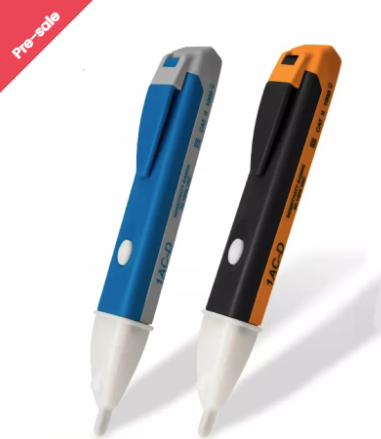
Electrical work in unlit environments introduces unique hazards. You often find yourself balancing a flashlight while attempting to probe live wires. Users evaluating a tool upgrade frequently wonder if the integration of a work light justifies replacing their standard non-contact tester. This dilemma brings us directly to a highly specific 2-in-1 tool. It solves the physical limitations of working in dark, cramped electrical environments. You no longer have to juggle multiple items when inspecting breaker panels during sudden blackouts.
This comprehensive guide explores the core value proposition of combining illumination with voltage detection. We will evaluate real-world workflows, examine crucial safety ratings, and break down the critical design differences between the Gen 1 and Gen 2 models. Our goal is to provide transparent, field-tested insights. You will learn exactly when this tool excels, where it falls short, and how it can streamline your diagnostic processes safely.
Key Takeaways
Primary Use Case: Best for fast, hands-free diagnostics in low-light environments (residential renovations, blackout troubleshooting).
Safety Standard: Features a CAT IV 1000V rating, covering both residential and industrial applications.
Critical Buying Context: The legacy model (2202-20) suffers from a notoriously difficult battery cap; the Gen 2 model (3202-20) resolves this and adds IP54 protection.
Limitation: Detects 50-1000V AC only (cannot test DC systems or automotive wiring).
The Business Problem: Why Combine a Voltage Detector with an LED?
Workflow Inefficiencies in the Field
Working in dark environments creates immediate workflow inefficiencies. Picture yourself navigating a dim attic or a cramped basement breaker box. You hold a flashlight in your left hand. You hold a standard Voltage Detector in your right hand. Suddenly, you need to push a cluster of wires aside. You lack a free hand. You might clamp the flashlight between your teeth or awkwardly tuck it under your chin. This common pain point leads to dropped tools, poor visibility, and increased safety risks. Combining the light source directly at the probe tip illuminates your exact target area. It frees up your secondary hand for safely managing the workspace.
The "Large Pen" Form Factor
Bulky diagnostic equipment belongs in a main tool bag, not in your immediate reach. We must evaluate a tool based on its accessibility. This specific device utilizes a compact form factor. It measures under six inches long. Its diameter mimics a large industrial marker or pen. A sturdy pocket clip secures it firmly to your shirt pocket or tool belt pouch. Because it weighs only a few ounces, it serves as a primary, always-on-hand diagnostic instrument. You do not need to walk back to your truck for a heavy multimeter just to verify if a single outlet has power.
Safety Verification Mechanisms
You should never trust your life to an electronic device without verifying its operational status. Best practices dictate testing any voltage sensing equipment on a known live source before use. However, battery failures remain a constant threat. This tool features a dedicated "Power On" green indicator light. This simple visual cue acts as a mandatory safety checkpoint. It confirms battery health and internal circuit readiness before you approach potentially live wires. If the green light fails to illuminate, you know immediately the device cannot safely detect voltage.
Top Practical Applications and Best Use Cases
Blackout and Outage Triage
Power outages create chaotic, low-visibility scenarios. When a primary grid fails, buildings rely on emergency lighting or plunge into total darkness. Facilities managers and electricians face the immediate task of isolating the fault. This integrated tool proves ideal for blackout triage. You can safely illuminate the breaker panel while simultaneously scanning for live "hot legs". You identify which specific circuits retain auxiliary power without needing secondary portable work lights. It allows rapid, safe diagnosis under high-stress conditions.
Older Home Renovations
Retrofitting older residential properties involves significant electrical guesswork. Houses built in the 1920s or 1950s often contain degrading cloth-covered wiring or complex, undocumented junction boxes. Standard multimeters require you to expose bare copper to take a reading. Stripping brittle, decades-old insulation often damages the wire. This non-contact tool excels here. You can map out active lines without stripping any protective insulation. You trace the current simply by bringing the tip near the outer jacket. It prevents unnecessary damage to fragile legacy electrical systems.
Drywall Line Tracing
Renovation projects frequently require cutting into finished walls. Striking a hidden live wire with a reciprocating saw poses severe electrocution and fire hazards. This device provides a valuable preliminary scanning function. It can sense live AC voltage through standard half-inch drywall. You slowly sweep the tip across the wall surface. The sensor locates active cables running between studs. This method is incredibly useful for locating cables before you drill, cut, or mount heavy hardware. Common Mistake: Do not rely on this method through thick plaster, metal lath, or conduit, as these materials block the electromagnetic field.
Key Evaluation Criteria: Safety, Range, and Usability
Professional diagnostic tools require strict adherence to performance metrics. We evaluate this device across three primary pillars: detection capabilities, safety compliance, and user interface design.
Detection Specifications
The device operates strictly within a 50-1000V AC range. It utilizes non-contact detection technology. The insulated plastic tip never physically touches bare metal or live current. Instead, it senses the electromagnetic field generated by alternating current. This specific voltage window covers standard residential outlets (120V/240V) up to industrial commercial lines (480V/600V). It completely ignores low-voltage systems like thermostats or doorbells operating under 50V. This intentional threshold prevents false-positive readings from harmless signal wires.
Safety Compliance
You must understand the safety ratings printed on your electrical tools. This unit carries a CAT IV 1000V safety rating. The International Electrotechnical Commission (IEC) establishes these categories. CAT IV represents the highest level of protection available for hand-held test equipment. It safeguards the user against severe transient overvoltage spikes. These spikes can occur from utility grid surges or nearby lightning strikes. A CAT IV rating means the tool can safely probe the origin of installation, such as utility transformers and primary distribution panels, without arc-flashing into your hand.
The Audio-Visual Feedback Loop
Clear communication between the tool and the user prevents lethal mistakes. The interface relies on a distinct audio-visual workflow.
Startup: You hold the rear power button for one second. The tip illuminates with a solid green light, accompanied by a double audio beep. The tool is now active and safe to use.
Detection: You bring the tip into close proximity to live AC voltage. The green light instantly changes to a bright red light. Simultaneously, the device emits a rapid, continuous beeping alarm.
Power Saving: If you place the tool back in your pocket and forget to turn it off, an auto-shutoff mechanism engages. After three minutes of complete inactivity, it powers down to preserve battery life.
Specification Category |
Metric / Detail |
Voltage Range |
50-1000V AC (Alternating Current) |
Safety Rating |
CAT IV 1000V |
Detection Type |
Non-Contact (Electromagnetic induction) |
Feedback Output |
Visual (Red/Green LED) + Audio (Beeper) |
Implementation Realities: Gen 1 (2202-20) Flaws vs. Gen 2 (3202-20) Fixes
Trust in a tool comes from understanding its evolution. We must transparently address the well-documented design flaws of the original model. Manufacturers rarely get everything perfect on the first attempt. Analyzing the shift from Gen 1 to Gen 2 reveals how user feedback shaped the current iteration.
The Gen 1 Limitation (Model 2202-20)
The original Gen 1 model delivered excellent detection accuracy but suffered from a catastrophic mechanical flaw. The battery cap mechanism was notoriously difficult to operate. Users frequently needed a flathead screwdriver to pry the rear cap off when replacing the AAA batteries. This rigid design utilized fragile plastic retaining clips. In cold weather, these clips became brittle and snapped off completely. Once the clip broke, the battery compartment would not stay closed, rendering the tool effectively useless. Furthermore, you could not operate the LED flashlight independently; turning on the light meant the voltage sensor was also fully active, draining the battery faster.
The Gen 2 Solutions (Model 3202-20)
The updated Gen 2 model addressed every major pain point reported by field technicians.
Quarter-Turn Cap: The engineering team completely redesigned the battery access. They replaced the fragile clips with a robust quarter-turn cap. You push down gently and twist. It completely resolves the battery replacement issue, even when wearing thick work gloves.
Independent Operation: You can now operate the LED light independently. A dedicated button allows you to use the tool purely as a pocket flashlight without activating the tester beep or draining sensor power.
Durability Upgrades: The Gen 2 features a reinforced polycarbonate tip. This resists snapping if the tool is dropped onto concrete.
Environmental Protection: It introduces an IP54 rating. This officially protects the internal circuitry against harmful dust ingress and splashing water, making it far superior for outdoor job sites.
Feature |
Gen 1 (2202-20) |
Gen 2 (3202-20) |
Battery Cap Design |
Fragile plastic clips (requires tool) |
Quarter-turn quick release |
Light Operation |
Tied to tester activation |
Independent switch |
Weather Resistance |
No official IP rating |
IP54 (Dust & Water Resistant) |
Probe Durability |
Standard plastic housing |
Reinforced tip design |
Shortlisting Logic: Is the Milwaukee Voltage Detector with LED Right for You?
Every tool purchase requires practical shortlisting logic. You need to align the tool's capabilities with your daily workflow. Not every technician needs a premium combination tool.
Who It Is Best For
This unit serves electricians, HVAC technicians, and facility managers exceptionally well. It fits the needs of serious DIYers who frequently work in unlit spaces like attics, crawlspaces, or utility closets. If your job requires you to consolidate pocket tools, this 2-in-1 device eliminates the need for a separate penlight. It streamlines your tool belt. It maximizes your mobility when inspecting dark electrical panels.
Who Should Pass
Auto-mechanics should skip this product entirely. Vehicle electrical systems operate on 12V or 24V DC. This unit detects AC only. Low-voltage technicians dealing with data cables, coaxial lines, or alarm systems will find no use for it. Their systems operate well below the 50V threshold. Additionally, if you are a homeowner who checks a wall outlet once a year, you may not justify the premium price tag. A basic, lightless pen tester will suffice for infrequent tasks.
Final Recommendation
If your workflow justifies the upgrade, you must explicitly verify your purchase. Ensure you select the milwaukee voltage detector with led Gen 2 (model 3202-20). Many retailers still stock the older Gen 1 model on clearance. Checking the model number guarantees maximum return on your investment. It ensures you avoid the legacy battery cap headache and benefit from the upgraded IP54 durability.
Conclusion
We have explored how combining reliable safety verification with practical job-site illumination transforms basic diagnostics. Navigating tight, dark spaces no longer requires juggling a flashlight and a sensitive test probe. The tool's integrated approach protects your workflow.
The CAT IV 1000V rating ensures maximum protection against dangerous transient overvoltage.
Non-contact technology allows you to map out circuits safely without stripping old, fragile wire insulation.
Upgrading specifically to the Gen 2 model eliminates historical design flaws, offering a durable quarter-turn battery cap and independent light control.
Remember its limitations: it serves strictly for AC applications above 50V and provides zero utility for DC automotive work.
Your next step involves evaluating your daily tool carry. Take inventory of how often you rely on a secondary light source while diagnosing power lines. If the friction of dark environments slows you down, check your local supplier inventory for the upgraded Gen 2 model. If your needs involve automotive systems or complex resistance testing, compare standard multimeters to secure the deeper diagnostic capabilities you require.
FAQ
Q: Can the Milwaukee voltage detector test DC voltage?
A: No, it is exclusively designed for 50-1000V AC (Alternating Current). It will not work for car batteries, automotive wiring, or low-voltage DC systems. You need a dedicated DC tester or a multimeter for those specific applications.
Q: Do I need to touch bare wires to get a reading?
A: No. It utilizes non-contact technology. Simply bringing the plastic tip close to the outlet faceplate or the outer jacket of an insulated wire is sufficient to detect a live hot leg. The tip never physically touches bare metal.
Q: What is the difference between Milwaukee 2202-20 and 3202-20?
A: Both feature LEDs, but the 3202-20 (Gen 2) fixes the older model's notoriously difficult battery cap with a quick quarter-turn design. It also adds an independent light switch, features a reinforced tip for better drop protection, and includes an IP54 weather rating.


