Introduction
Spikes and crampons look similar, but they serve different purposes. This confusion appears often in work and outdoor settings.
In this article, we explain how Tree Climbing Spikes differ from crampons. You will learn their purpose, design logic, and correct use to avoid safety risks.
What Are Tree Climbing Spikes?
Definition and Primary Purpose
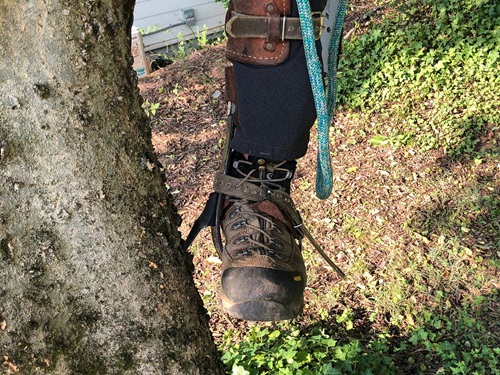
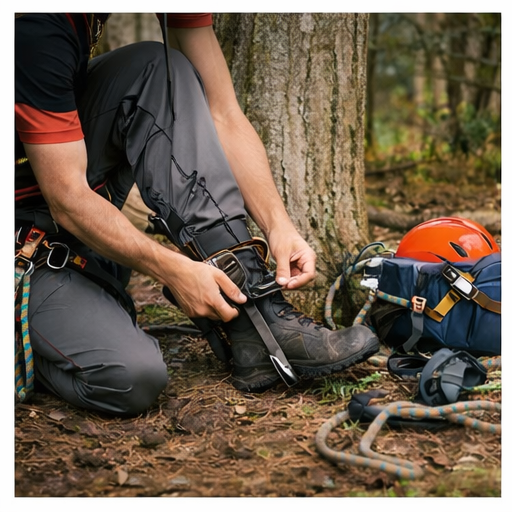
Tree Climbing Spikes are specialized climbing tools designed for vertical movement on wooden structures. They attach to the lower leg and boot, using a fixed metal gaff to anchor into the tree surface. Unlike traction devices meant for ground contact, these tools support upward and downward movement along a trunk. The primary purpose of Tree Climbing Spikes is to provide stable positioning during vertical work, not horizontal travel. They allow the climber to transfer body weight into the tree with controlled, repeatable steps. This design supports precise movement where hands remain free for tools and safety systems. Key functional characteristics include:
● Leg-mounted structure that distributes load through the lower body
● Fixed spike orientation for predictable penetration
● Compatibility with harness-based climbing systems
Typical Applications in Arborist and Utility Work
Tree Climbing Spikes are widely used in arborist and utility tasks where tree preservation is not required. Common applications include tree removal, sectional dismantling, and controlled repositioning during cutting operations. In these scenarios, controlled penetration into the trunk improves balance and reduces reliance on continuous rope adjustment. They are also used on wooden utility poles during inspection or maintenance work. These environments are structured and predictable, which suits spike-based movement. Typical use cases involve:
● Ascending a trunk during tree removal operations
● Holding position while cutting or rigging sections
● Climbing wooden poles in electrical or communication work The tool choice reflects task requirements rather than terrain difficulty.
Material Interaction: How Spikes Work on Wood
Tree Climbing Spikes function through direct penetration into bark and underlying wood fibers. The gaff enters the material at a shallow angle, creating resistance through compression rather than surface friction. This interaction provides stable support even on vertical surfaces. Wood deforms locally under load, which helps lock the spike in place during weight transfer. This mechanism differs fundamentally from traction on ice or snow, where grip depends on surface hardness and edge contact. The difference in material interaction can be summarized as follows:
Surface Type | Interaction Method | Stability Source |
Wood | Penetration and compression | Material deformation |
Ice or Snow | Surface grip and edge bite | Friction and hardness |
Because of this distinction, Tree Climbing Spikes are unsuitable for frozen or rocky terrain. Their effectiveness depends entirely on wood structure and controlled working conditions.
What Are Crampons?
Definition and Intended Environment
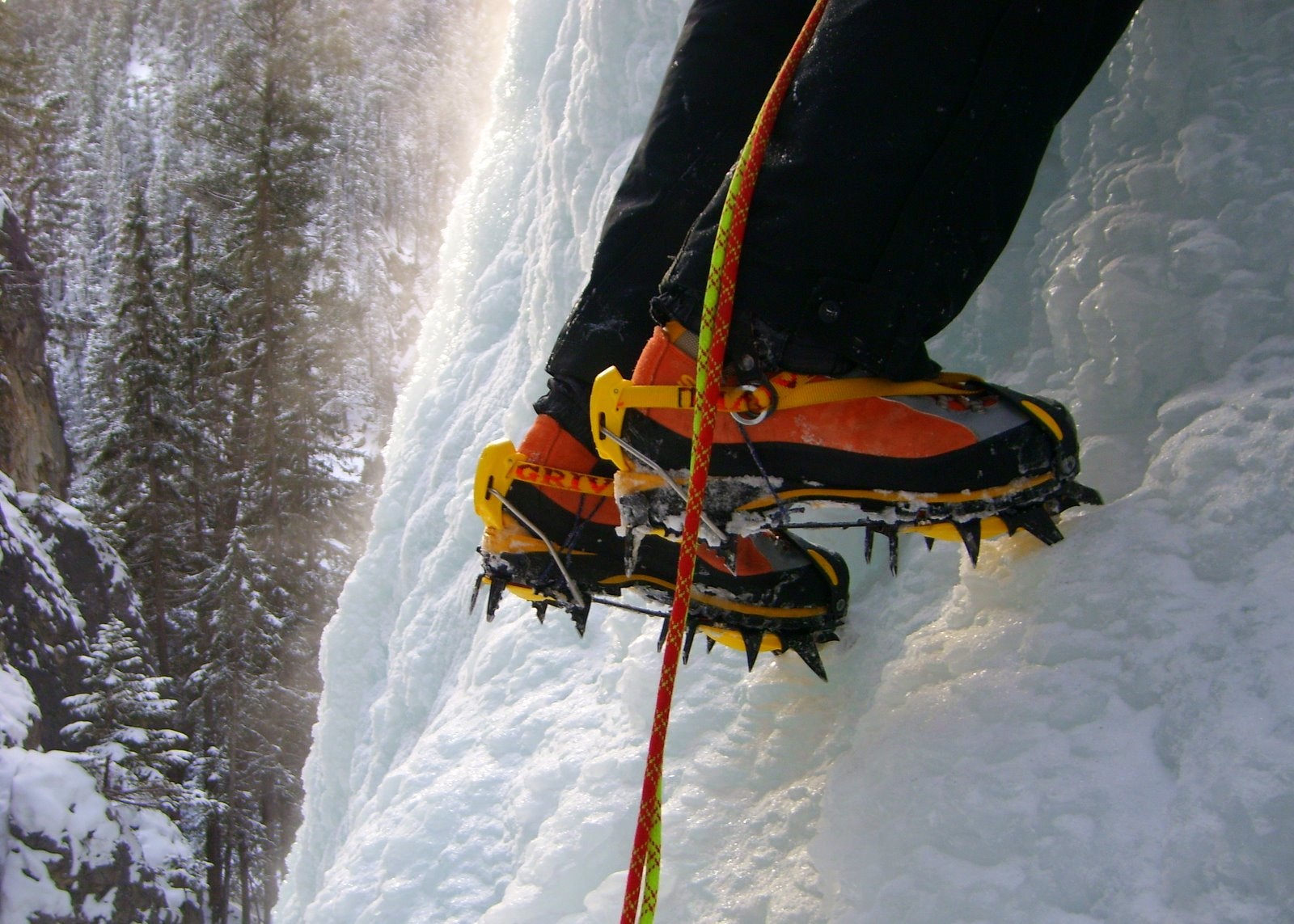
Crampons are traction devices designed for movement on ice, snow, and frozen ground. They attach to the sole of a boot and provide grip where normal footwear slips. Unlike Tree Climbing Spikes, crampons do not penetrate a surface. They rely on contact between metal points and hard, frozen terrain. Their typical environment includes winter mountains, glaciers, and icy slopes. In these settings, a loss of traction can lead to uncontrolled sliding. Common situations where crampons are used include:
● Winter mountaineering routes with sustained snow cover
● Glacier travel with hard-packed or refrozen surfaces
● Steep alpine terrain during cold seasons They are built for outdoor travel where the ground condition is unpredictable and often unforgiving.
Design Characteristics
Crampons use a rigid or semi-rigid metal frame fitted with multiple sharp points. These points extend downward and, in some designs, forward from the boot. The layout allows the foot to engage the surface from different angles. Edge grip supports side-stepping across slopes, while forward points support climbing steeper sections. The structure does not flex freely, which helps maintain consistent contact on hard ice. Key design elements include:
● Multiple downward-facing points for general traction
● Forward-facing points for steep or vertical movement
● A rigid frame that resists bending under load This design prioritizes stability on frozen surfaces rather than adaptability to soft materials.
Footwear and Skill Requirements
Crampons require compatible footwear to function correctly. Boots must provide enough stiffness to support the metal frame without excessive flex. Soft footwear reduces control and increases the risk of detachment or failure. Attachment systems vary, but all depend on a secure interface between boot and crampon. Proper fitting is essential before use. Skill and experience also play an important role:
● Users must understand how to walk, turn, and stop safely on ice
● Movement techniques differ from normal hiking
● Training helps reduce the risk of tripping or catching points Crampons are tools for high-risk environments where technique matters as much as equipment choice.
Tree Climbing Spikes vs Crampons: Core Differences Explained
Surface Compatibility
Tree Climbing Spikes and crampons are designed for fundamentally different surface conditions. Tree Climbing Spikes work exclusively on wood, where controlled penetration into bark and fibers provides support. Crampons are intended for ice and snow, where penetration is shallow and grip depends on surface hardness. Each tool assumes a predictable interaction with its target surface. Using either tool outside that environment reduces stability and increases risk. The contrast can be understood through surface behavior:
● Wood deforms under load and accepts penetration
● Ice and snow resist penetration and require edge grip Because of this difference, surface compatibility is the first factor that separates these tools.
Spike Geometry and Penetration Behavior
The geometry of Tree Climbing Spikes is optimized for controlled entry into wood. The spike length is limited and shaped to resist pull-out during vertical loading. Penetration depth remains shallow but consistent, which helps maintain balance. Crampon points are longer and sharper, designed to bite into frozen surfaces rather than enter deeply. Their geometry supports weight transfer across multiple points. Key differences in geometry include:
● Short, fixed gaffs on Tree Climbing Spikes
● Multiple downward and forward points on crampons Penetration depth directly affects stability, especially during movement and repositioning.
Attachment and Movement Mechanics
Tree Climbing Spikes use leg-mounted systems that transfer load through the lower leg and foot. This setup allows the climber to move vertically while keeping hands available for work. Movement relies on alternating steps and controlled weight shifts. Crampons attach to the sole of the boot and move as part of the foot. They are designed for walking, side-stepping, and climbing across slopes. The attachment method influences movement:
● Leg-mounted systems support vertical positioning
● Sole-mounted systems support forward and lateral travel These mechanics reflect the tasks each tool is meant to perform.
Aspect | Tree Climbing Spikes | Crampons |
Primary Surface | Wood (tree trunks, wooden poles) | Ice, snow, frozen terrain |
Interaction Method | Controlled penetration into bark and wood fibers | Edge grip and point bite on hard surfaces |
Spike / Point Design | Short, fixed gaff designed to resist pull-out | Multiple long metal points, including front points |
Penetration Depth | Shallow and consistent | Minimal penetration, relies on surface hardness |
Attachment Method | Leg-mounted system integrated with boot and straps | Sole-mounted frame attached directly to the boot |
Typical Movement | Vertical ascent and static positioning | Forward walking, side-stepping, and slope climbing |
Body Position | Upright, close to the surface | Forward-leaning or edge-loaded stance |
Slip Consequence | Usually limited by ropes and work positioning | Potential for uncontrolled sliding in exposed terrain |
Training Focus | Placement accuracy and positioning control | Terrain awareness, movement technique, and fall prevention |
Movement Patterns and Body Positioning
Tree climbing relies on upright posture and close body alignment with the trunk. Tree Climbing Spikes support small, deliberate steps while maintaining contact with ropes or lanyards. Body positioning remains vertical, with weight centered over the spike. Crampon use involves a forward-leaning stance on slopes. Users shift weight across edges or front points depending on terrain angle. Movement patterns differ in practice:
● Vertical ascent and static positioning in tree work
● Continuous forward travel and edge loading on ice Each pattern demands a different balance strategy.
Risk Profiles and Consequences of Slippage
The consequences of slipping vary between tree work and alpine terrain. In tree climbing, falls are often limited by ropes and controlled work zones. Slippage usually results from poor placement rather than surface failure. In icy terrain, a crampon slip can trigger an uncontrolled slide. The environment often lacks natural stopping points. Risk profiles reflect these conditions:
● Localized risk in controlled tree work
● High-consequence risk in exposed mountain terrain Understanding this difference shapes tool selection and behavior.
Skill and Training Expectations
Professional tree climbing requires learning how to place spikes correctly and manage body weight. The learning curve focuses on balance, positioning, and coordination with safety systems. Crampon use demands training in movement techniques, fall prevention, and self-arrest skills. Errors can escalate quickly in icy environments. Training expectations differ in scope:
● Task-specific skill development for tree climbing
● Broad terrain and risk management skills for crampons Each tool assumes a different level of environmental awareness and experience.
Decision Factors: How to Choose the Right Tool
Surface Type as the Primary Criterion
Surface type is the first and most reliable factor when choosing between tools. Tree Climbing Spikes are designed for wood, where controlled penetration into bark and fibers provides support. Crampons are designed for ice and snow, where grip depends on edge contact and surface hardness. Mixed terrain requires careful judgment, because neither tool performs well outside its intended surface. A practical way to evaluate surface compatibility is:
● Wood surfaces favor penetration-based tools
● Ice and snow favor traction-based tools
● Mixed terrain increases uncertainty and risk Choosing based on surface type prevents misuse before other factors are considered.
Surface Condition | Suitable Tool | Primary Interaction |
Tree trunks, wooden poles | Tree Climbing Spikes | Penetration and compression |
Ice, hard-packed snow | Crampons | Edge grip and point bite |
Mixed or changing terrain | Context-dependent | Requires reassessment |
Consequence of a Slip
The consequence of losing grip often matters more than convenience or comfort. In tree work, falls are usually managed through ropes, harnesses, and controlled positioning. A slip may lead to a short drop or loss of balance rather than a long slide. In icy terrain, a crampon slip can result in rapid, uncontrolled movement over distance. Risk evaluation should focus on outcomes:
● Low-risk environments allow for correction after a slip
● High-risk environments punish small mistakes immediately When consequences are severe, conservative tool choice becomes essential. Convenience should never override risk assessment.
Professional Context and Training Level
Tool choice also depends on professional role and experience. Arborists and utility workers operate in managed environments with known surfaces. Their training focuses on placement accuracy, body positioning, and integration with safety systems. Tree Climbing Spikes align with these task-specific demands. Mountaineers operate in variable terrain where conditions change quickly. Experience shapes decision-making:
● Arborist work emphasizes controlled movement and repeatability
● Mountaineering emphasizes terrain reading and movement adaptation Matching the tool to both the task and the user’s training reduces error and improves safety.
Common Misunderstandings About Spikes and Crampons
Functional Comparison Table
Misunderstanding often comes from assuming that spikes and crampons serve similar purposes. A side-by-side comparison helps clarify their intended roles and limitations. Tree Climbing Spikes and crampons differ in surface interaction, attachment method, and movement style. Viewing these differences together reduces confusion and supports faster decision-making. This comparison focuses on function rather than appearance.
Aspect | Tree Climbing Spikes | Crampons |
Intended Surface | Wood, tree trunks, wooden poles | Ice, snow, frozen ground |
Attachment Style | Leg-mounted system | Sole-mounted frame |
Movement Type | Vertical ascent and positioning | Forward walking and slope travel |
Surface Interaction | Penetration into wood | Edge grip on hard surfaces |
Risk Profile | Controlled, rope-managed work | High-consequence terrain |
Why Tree Climbing Spikes Are Not “Crampons”
The confusion often starts with visual similarity. Both tools use metal points and attach near the foot. This appearance leads some users to group them together. Functionally, they solve different problems. Tree Climbing Spikes are designed to enter a soft material and hold position. Crampons are designed to grip a hard surface without penetrating it. Terminology also plays a role:
● The word “spikes” suggests general traction
● “Crampons” is sometimes used loosely for any spiked device Clear naming helps users understand that these tools are not interchangeable.
Misuse Scenarios and Safety Implications
Applying the wrong tool to the wrong environment creates predictable risks. Using Tree Climbing Spikes on ice provides no reliable grip and increases fall risk. Using crampons on trees damages the surface and reduces control. These mistakes often come from convenience or incomplete understanding. Common misuse patterns include:
● Assuming spikes work on any slippery surface
● Using crampons where penetration is required The practical consequence is loss of stability in situations where correction time is limited.
Key Takeaways for Fast Decision Reference
Clear rules help prevent misuse without complex analysis. Purpose-driven selection keeps decisions simple and consistent. The following guidelines reduce ambiguity:
● Choose penetration-based tools for wood
● Choose traction-based tools for ice and snow
● Reassess tool choice when surfaces change These rules reinforce the idea that function, not appearance, defines the right tool.
Conclusion
This article clarifies the fundamental difference between Tree Climbing Spikes and crampons. They are designed for different surfaces, risks, and working purposes.
Correct tool selection depends on surface type and slip consequences. Clear understanding helps prevent misuse and improve safety.
Products from JITAI Electric Power Equipment Co., Ltd. emphasize stable climbing and durable design. Their equipment supports professional work through reliable performance and practical safety.
FAQ
Q: In professional operations, when are Tree Climbing Spikes required?
A: Tree Climbing Spikes are required for controlled vertical work on wood, such as tree removal or utility pole access, where penetration provides stable positioning.
Q: How do Tree Climbing Spikes differ operationally from crampons?
A: Tree Climbing Spikes penetrate wood for vertical positioning, while crampons rely on edge grip for ice and snow travel in high-risk terrain.
Q: What risks arise from using Tree Climbing Spikes on icy surfaces?
A: Tree Climbing Spikes cannot grip ice, leading to loss of stability, uncontrolled slips, and higher safety risk in frozen environments.
Q: Are Tree Climbing Spikes suitable for mixed or changing terrain?
A: Tree Climbing Spikes are unsuitable for mixed terrain, as performance depends on consistent wood surfaces and controlled working conditions.


