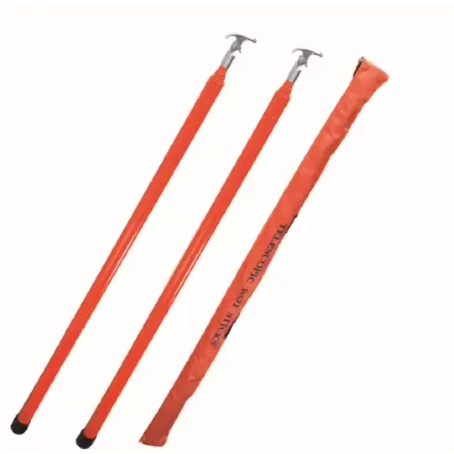
Small damage rarely announces itself. A faint dull patch, a slight wobble in a locking section, a thin dark line along the surface—these details are easy to overlook during a busy shift. Yet when working around energized systems, guessing wrong carries serious consequences. Recognizing the early warning signs of a hot stick that is no longer safe is one of the most important habits in live-line operations. This article provides a practical and structured checklist for identifying damage, understanding why each defect matters, and knowing the safest next step.
A reliable inspection routine protects both personnel and equipment. It also protects investment value. Because a hot stick is designed as a safety tool, its integrity must never be assumed. It must be verified.
First principle: if it can affect insulation or mechanical integrity, it is damage
Before listing specific defects, it is essential to understand a simple rule. Any condition that reduces insulation strength or compromises structural stability must be treated as damage. Damage is not limited to visible cracks. It includes contamination, deformation, surface degradation, and mechanical instability.
Professional safety standards emphasize two major categories during hot stick inspection: electrical insulation condition and mechanical reliability. If either is uncertain, the tool should not be used.
What “defect or contamination” really means in daily work
In practical terms, a defect is anything that interrupts the uniform insulation surface or changes the intended structural strength. Contamination refers to foreign material that can alter surface resistance. Oil residue, salt deposits, industrial dust, and even hardened adhesive marks fall into this category.
The purpose of inspection is not to find dramatic failures. It is to detect subtle changes before they escalate into electrical tracking, flashover risk, or mechanical collapse during use.
Visual red flags on the pole surface
The body of a hot stick is its primary insulation barrier. Surface integrity is therefore critical.
Cuts, gouges, cracks, and dents
A cut through the outer finish may appear small, but it can expose fiberglass fibers beneath the protective coating. When moisture contacts exposed fibers, insulation resistance decreases. Repeated voltage stress may then cause tracking along the damaged path.
Dents and impact marks indicate that the stick may have experienced mechanical shock. Even if the outer layer appears intact, internal fiber alignment may be compromised. For this reason, impact marks should never be ignored.
Dull finish, delamination, and flaking
A healthy hot stick typically has a smooth, uniform surface. If areas become matte, chalky, or begin to peel, this indicates coating degradation. Delamination occurs when the protective layer separates from the fiberglass core.
When the finish fails, surface moisture control is reduced. This increases the likelihood of leakage current during wet conditions. Finish deterioration is therefore not cosmetic—it directly affects dielectric performance.
Tracking marks, burn patterns, and blistering
Dark lines or burn-like streaks along the surface often indicate electrical tracking. Tracking is a sign that electrical stress has already partially discharged along the exterior.
Blistering or localized surface bubbles may suggest overheating or insulation breakdown. When these signs appear, immediate removal from service is the safest action. Continued use increases risk dramatically.
ZHEJIANG JITAI ELETCIRC POWER EQUIPMENT CO.,LTD emphasizes smooth, durable surface finishing during manufacturing to minimize the likelihood of early surface degradation. Consistent coating quality improves cleanability and long-term reliability.
Red flags on fittings, joints, and telescopic locks
Inspection does not end at the fiberglass surface. Mechanical components play an equally critical role.
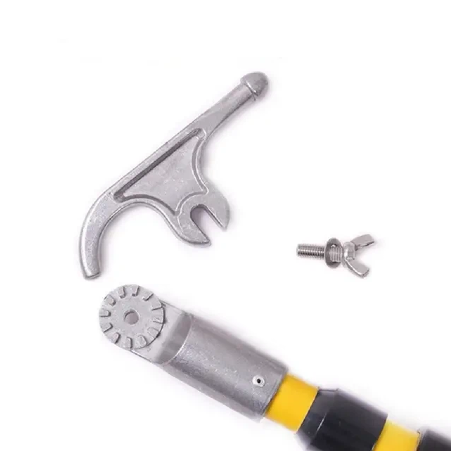
Loose or cracked end fittings
The universal head fitting connects attachments to the pole. If the fitting is loose, cracked, or corroded, the attachment may detach during operation. This creates both electrical and mechanical hazards.
Burrs or sharp edges on fittings may also damage attachment components or gloves. Stability at the head ensures accurate control when operating disconnect switches or grounding equipment.
Lock instability in telescopic designs
Telescopic hot sticks depend on secure locking systems. During inspection, sections should extend smoothly and lock firmly. If the locking button does not fully seat, if sections wobble, or if rotation occurs unexpectedly, the tool should not be used.
Unexpected collapse under load can cause sudden loss of control. In live-line conditions, stability is essential.
Heavy-duty triangular and no-twist designs offered within the Telescopic Disconnect Tools range help reduce unwanted rotation and improve mechanical confidence during switching tasks.
Contamination that counts as damage
Not all damage involves cracks or broken parts. Surface contamination can be just as dangerous.
Sticky residues and grease films
Oil, adhesive residue, and industrial grease can form thin conductive films. Even when invisible, these films lower surface resistance in humid environments.
If cleaning does not restore a smooth finish, further evaluation is necessary.
Salt fog and industrial deposits
Coastal and industrial areas expose tools to salt and chemical particles. These accumulate gradually and may not be noticeable without careful inspection.
Salt contamination combined with moisture dramatically increases leakage current risk. Regular cleaning is therefore essential in such environments.
Water films and wet conditions
Water alone does not permanently damage fiberglass. However, when combined with contamination or surface degradation, it amplifies insulation weakness.
A hot stick should always be dry and clean before use. Even in damp climates, proper wiping and storage maintain reliability.
What to do when you find a problem
Discovering damage is not the time for improvisation.
Tag out and remove from service
If inspection reveals cracks, tracking, structural instability, or significant contamination, the tool must be removed from service immediately. Tagging the tool prevents accidental reuse.
Following internal inspection and testing procedures ensures consistent safety management.
Why quick fixes are risky
Temporary repairs, such as covering cracks with tape or tightening damaged fittings without full inspection, introduce uncertainty. Surface integrity and traceability are critical in live-line tools.
A controlled evaluation process, including dielectric testing when necessary, protects both personnel and compliance documentation.
Because ZHEJIANG JITAI ELETCIRC POWER EQUIPMENT CO.,LTD integrates advanced quality inspection equipment and systematic quality management, each manufactured hot stick is designed to minimize early failure risk. However, even the best manufacturing cannot replace disciplined field inspection.
Table — Damage signs and the safest response
Sign | What it may imply | Safest next step |
Crack or cut through finish | Compromised insulation path | Remove from service for evaluation |
Tracking or burn marks | Prior surface discharge | Immediate tag-out; do not reuse |
Dull or flaking surface | Coating degradation | Clean and assess; consider refinishing |
Loose head fitting | Reduced attachment control | Stop use and repair |
Lock will not hold | Risk of collapse during extension | Stop use and inspect locking system |
This checklist transforms inspection from guesswork into structured decision-making.
Why early detection protects long-term investment
Replacing a hot stick prematurely increases cost. Ignoring damage increases risk. The balance lies in timely identification.
Routine hot stick inspection ensures that tools remain within safe performance margins. It also extends usable life because minor contamination can be corrected before permanent degradation occurs.
Design features such as smooth cleanable surfaces, reinforced fiberglass cores, and stable locking systems reduce the likelihood of premature failure. Within the Telescopic Disconnect Tools category, models are engineered for durability, easy cleaning, and structural stability across transmission and distribution applications.
By combining disciplined inspection with high-quality manufacturing, operators maintain both safety and operational efficiency.
Conclusion
Most incidents are prevented by spotting small defects before they become serious hazards. A systematic hot stick inspection routine—focused on surface integrity, contamination control, and mechanical stability—ensures that damage is identified early. ZHEJIANG JITAI ELETCIRC POWER EQUIPMENT CO.,LTD designs and manufactures tools with smooth finishes, robust universal heads, and stable anti-twist structures to support reliable field performance. Review our Telescopic Disconnect Tools options and request the right configuration for your working environment. For technical specifications or bulk inquiries, contact us to learn more about our insulated operating pole solutions.
FAQ
1. How often should a hot stick be inspected?
A visual inspection should be performed before each use, with periodic formal testing according to internal safety programs.
2. Is a dull surface automatically considered damage?
Not always, but it may indicate coating degradation. Cleaning and evaluation are recommended before further use.
3. Can a loose telescopic lock be tightened and reused immediately?
If a lock does not hold securely, the tool should be removed from service until inspected and confirmed safe.
4. Why is contamination treated as damage?
Contamination reduces surface insulation resistance, especially in wet conditions, increasing the risk of electrical tracking.


