Flipping the main breaker does not guarantee a de-energized workspace. Faulty ground-fault circuit interrupters (GFCIs), miswired circuits, or shared neutrals can easily leave lethal voltage in supposedly dead lines. A commercial electric voltage detector is the critical final line of defense between an electrician and an arc flash or fatal shock. We rely on these essential tools daily. They confirm our environment is safe before we touch a single wire. Before standardizing equipment for your facility or toolbelt, you must understand their exact commercial applications. It is vital to learn the limitations of different detector types. You must also implement the strict safety protocols required to prevent false negatives. You will discover how to evaluate these tools properly. By following these guidelines, you will establish rigorous safety standards to protect your team on every single job.
Key Takeaways
Primary Application: Used to verify the presence or absence of electrical voltage during preventative maintenance, renovations, and emergency disaster recovery.
Technology Choice: Non-contact detectors offer fast, safe sweeps, while contact testers provide precise diagnostic verification.
Safety Imperative: "False readings" from low batteries or uncalibrated tools are a primary industry hazard; utilizing the "Live-Dead-Live" pre-test method is non-negotiable.
Buying Consideration: Commercial selection must account for IEC safety ratings (CAT III/IV), proving unit compatibility, and probe length for tamper-resistant outlets.
The Core Commercial Applications of Voltage Detectors
Commercial environments present unique electrical hazards. Heavy machinery, complex sub-panels, and undocumented legacy wiring complicate routine tasks. You cannot afford to guess if a circuit is live. A reliable testing protocol prevents catastrophic accidents. We use these critical safety devices across several core applications.
Pre-Renovation Verification: Tearing down commercial drywall exposes workers to hidden conduits. You must confirm lines are entirely de-energized before demolition or structural alterations begin. This crucial step mitigates accidental strikes. A saw blade hitting a live wire can trigger a massive arc flash. This explosion can cause severe burns or ignite surrounding building materials.
Preventative Panel Maintenance: Industrial switchgears require regular electrical inspections. Technicians use these tools for safely scanning breaker panels and switchgears. They look for localized faults without exposing themselves to unnecessary direct-contact risks. You can identify problematic breakers quickly while maintaining a safe physical distance from exposed busbars.
Phase and Wiring Troubleshooting: Many older commercial junction boxes lack proper documentation. You often encounter a chaotic mix of cables. We rely on detectors for identifying hot wires (typically red/black), neutrals (white), and grounds (green/bare) in complex junction boxes. Never trust wire insulation color alone. Always test the conductor directly to confirm its true status.
Emergency Response & Disaster Recovery: Flooded facilities and post-fire environments create severe hazard zones. Water and exposed wiring form a highly lethal combination. Emergency teams use detectors for assessing live currents in these chaotic environments. They sweep the standing water and damaged panels. This ensures the area is electrically safe before intensive rescue or cleanup operations commence.
Contact vs. Non-Contact: Selecting the Right Diagnostic Tool
Selecting the appropriate diagnostic tool depends entirely on your specific task. Choosing the right Voltage Detector ensures you get accurate readings while maintaining personal safety. They fall into two primary categories. Each type serves a highly distinct purpose in the field.
Non-Contact Voltage Detectors (NCVDs)
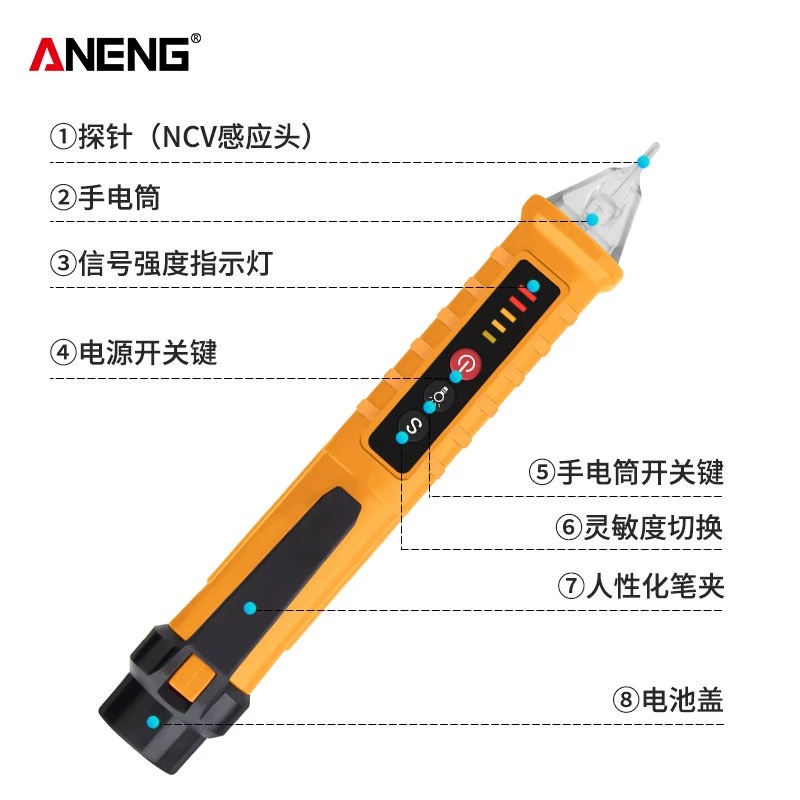
These pen-like devices are the most common initial testing tools found in a commercial toolbelt. They prioritize user safety by eliminating direct physical contact.
Mechanism: Uses capacitive coupling to detect electromagnetic fields without touching exposed metal. The sensor detects the electric field radiating from a live conductor.
Best For: Rapid safety sweeps, tracing hidden wires through conduit or drywall, and identifying active circuits safely. You can quickly scan a dozen outlets in seconds.
Limitations: Lower precision; susceptible to "ghost voltage" or interference from adjacent heavily loaded cables. They cannot distinguish between closely bundled wires accurately.
Contact Voltage Testers
When you need absolute certainty, you must use a contact tester. These tools provide definitive proof of electrical potential.
Mechanism: Requires direct physical connection to the circuit. For example, you must touch one lead to ground and the other directly to the hot wire.
Best For: Pinpoint diagnostics and definitive verification. Many traditional models use neon/LED indicators requiring no internal battery. This brilliant design reduces potential points of failure.
Limitations: Requires exposing live metal, necessitating stricter PPE compliance. You face a higher risk of accidental shocks if you slip while holding the probes.
Multimeters vs. Detectors
Many apprentices confuse the roles of these devices. Detectors answer a simple, binary question: Is dangerous voltage present? They provide a quick yes or no. Conversely, multimeters measure specific numerical values. They check electrical continuity and resistance. Detectors absolutely cannot perform continuity checks. You should use a detector for immediate safety verification. You use a multimeter later for in-depth system troubleshooting.
Feature | Non-Contact Detector | Contact Tester | Digital Multimeter |
Primary Function | Safety sweep / Presence check | Definitive verification | Detailed diagnostics |
Physical Contact | None required | Required (Metal to Metal) | Required (Metal to Metal) |
Battery Dependency | Always required | Often not required | Always required |
Continuity Testing | No | No | Yes |
Key Evaluation Criteria for Commercial Procurement
Commercial procurement requires strict adherence to international safety standards. You cannot buy cheap, unrated consumer tools for industrial jobs. The environment dictates the equipment specifications. Evaluating these tools correctly prevents dangerous equipment failures during critical operations.
IEC Measurement Category (CAT) Ratings
Devices must match the environment perfectly. The International Electrotechnical Commission (IEC) defines these mandatory safety categories. Commercial electrical work typically requires CAT III or CAT IV ratings. A CAT III rating covers distribution panels, commercial lighting circuits, and heavy appliance loads. A CAT IV rating covers utility-level connections, outside service drops, and primary supply sources. Using an under-rated tool invites disaster. A high-energy transient overvoltage can literally blow the tool apart in your hands.
IEC Rating | Typical Application Environment | Hazard Level |
CAT II | Single-phase receptacle loads, household appliances. | Low (Not suitable for commercial panels) |
CAT III | Distribution panels, commercial lighting, heavy motors. | High (Standard commercial requirement) |
CAT IV | Utility drops, primary feed lines, outdoor installations. | Extreme (Maximum transient protection) |
Probe Design and Physical Constraints
C-suite buyers and independent contractors often overlook physical ergonomics. You must evaluate the physical probe design carefully. Modern commercial buildings frequently install tamper-resistant outlets. These child-proof receptacles feature stubborn internal shutters. Short contact probe leads cannot bypass these shutters easily. Ensure contact probe leads are long enough to bypass the internal shutters of modern tamper-resistant outlets. They must reach the internal copper contacts safely without bending, breaking, or slipping.
Sensory Feedback Reliability
Industrial environments are generally loud and poorly lit. You cannot rely on a single tiny indicator bulb. High-noise or low-visibility industrial environments demand dual-indicator systems. You need both high-decibel audible alarms and bright visual LEDs. We strongly recommend models featuring tactile vibration. This extra sensory feedback ensures you never miss a warning signal while wearing heavy ear protection.
High-Voltage Proving Unit Compatibility
Heavy commercial and substation work involves massive, unforgiving energy levels. For heavy commercial or substation work, detectors should pair seamlessly with a High Voltage Proving Unit (HVPU). A proving unit generates a known, safe electrical field. You use it to mechanically verify the detector's functionality before use. This critical pairing guarantees your safety gear operates perfectly before you enter a deadly high-voltage zone.
Managing Risks: False Readings and Implementation Protocols
Even the finest equipment cannot replace strict safety protocols. Human error remains the largest threat on any job site. You must train your team to recognize and manage operational risks. A well-trained electrician questions every reading until verified.
The Danger of False Negatives
The most fatal flaw of any voltage detector is indicating a dead line when voltage is actually present. This false sense of security leads directly to severe injuries. This failure is typically caused by drained batteries or dropped, damaged equipment. You must inspect your tools daily. If a pen rattles or shows casing cracks, discard it immediately. Never trust your life to a device exhibiting erratic behavior.
The "Live-Dead-Live" Standard
The electrical industry mandates a strict, repeatable verification process. National safety frameworks endorse this exact procedure. You must follow it every single time you work. The "Live-Dead-Live" standard is completely non-negotiable.
Test the detector on a known live circuit. Confirm the device beeps and flashes properly. This proves the batteries and sensors work.
Test the target circuit to confirm it is de-energized. Perform your required safety sweep on the specific work area.
Re-test on the known live circuit. This final step verifies the detector did not fail randomly during step two.
Mitigating False Positives
Non-contact pens frequently trigger false positive alarms. You must understand how static electricity, friction, or parallel cable runs can trigger non-contact pens. "Ghost voltage" occurs when an energized wire inductively couples with an adjacent dead wire. The pen senses the resulting weak field. Train staff to cross-verify anomalies with a contact tester or multimeter. Do not simply assume a line is hot. Dig deeper to find the true source.
Standardizing PPE
A testing device never replaces proper safety gear. It serves merely as an informational indicator. A voltage detector does not replace insulated gloves, arc-rated clothing, and safety glasses. You must protect yourself physically. Treat every single circuit as fully energized until you completely prove otherwise using the methods detailed above.
Conclusion
Summary: A commercial electric voltage detector is not a general-purpose diagnostic tool; it is a specialized, binary safety device designed to verify life-threatening hazards. It protects professionals from unseen dangers.
Next Steps: Audit your team’s current testing equipment. Discard unrated or physically damaged units immediately. Ensure compatibility with tamper-resistant infrastructure to prevent field frustration. Finally, mandate the adoption of Proving Units for high-voltage commercial applications to guarantee absolute equipment reliability.
FAQ
Q: Can a commercial electric voltage detector measure continuity?
A: No. Voltage detectors only identify the presence of voltage. They operate as simple binary safety tools. To test wire continuity or measure resistance accurately across a circuit, a digital multimeter is required.
Q: Why is my non-contact voltage detector beeping near a dead wire?
A: This is often due to "ghost voltage" (capacitive coupling from nearby live wires) or static electricity. The high sensitivity of the sensor picks up these stray fields. If in doubt, verify the wire's true status with a contact tester.
Q: Do all voltage detectors require batteries?
A: No. While all non-contact pens require batteries to power their sensors and alarms, traditional contact testers (often using neon bulbs) draw power directly from the circuit being tested to illuminate the indicator.
Q: How do I test a 220V commercial line with a standard tester?
A: Using a rated dual-voltage contact tester, testing across the two hot legs will typically illuminate both the 110V and 220V indicators simultaneously, confirming the higher voltage presence. Always follow the manufacturer's specific reading instructions.


