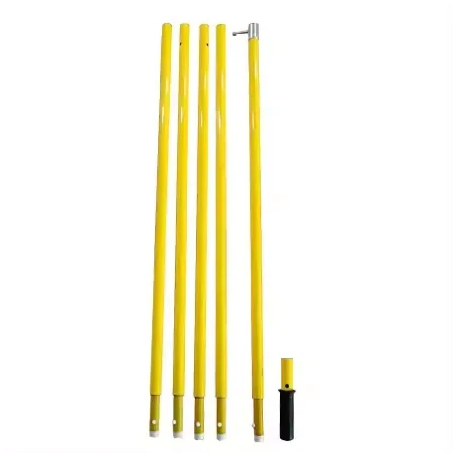
Two crews may purchase the same model in the same year, yet five years later only one tool remains in active service. The difference is not luck. The lifespan of a hot stick is never determined by its manufacturing date alone. It is determined by condition, testing history, maintenance discipline, and storage environment. When buyers ask how many years a hot stick will last, the more accurate question is: under what conditions will it remain safe to use?
Understanding this distinction is essential before purchasing or deploying any live-line tool. Lifespan is closely connected to surface integrity, inspection routines, structural design, and quality control at the manufacturing stage. This article explains what truly determines service life, why two identical tools can age differently, and how selecting the right structure from the beginning can reduce long-term operational costs.
“Lifespan” Has Two Meanings: Service Life vs Safe-to-Use Life
The word lifespan is often used loosely. In practice, it has two separate meanings.
Service life refers to how long a tool physically exists and can still be assembled or extended. Safe-to-use life refers to how long it can reliably meet insulation and mechanical performance requirements under field conditions.
These two timelines are not always the same.
A Stick Can Look Fine and Still Fail a Wet Test
A hot stick may appear visually acceptable yet fail electrical testing. This usually occurs because insulation performance depends heavily on surface condition. Contamination, microscopic cracks in the finish, or absorbed moisture can reduce dielectric strength without obvious external damage.
During wet withstand testing, water is applied to simulate real environmental conditions. If current leakage exceeds acceptable limits, the stick is removed from service. This demonstrates that insulation reliability is not judged by appearance alone.
This is why manufacturing quality and finishing processes matter from the beginning. Uniform resin curing, smooth surface coating, and structural integrity reduce long-term degradation risks. At ZHEJIANG JITAI ELETCIRC POWER EQUIPMENT CO.,LTD, strict inspection protocols ensure that each hot stick leaves the factory with consistent dielectric properties and surface quality, providing a stable foundation for extended service life.
What Utilities Mean by “Remove from Service”
In professional environments, “remove from service” does not necessarily mean the tool is broken. It means risk cannot be confidently controlled.
Utilities adopt a conservative safety mindset. If a hot stick shows signs of tracking, contamination that cannot be cleaned, surface delamination, or lock instability, it is withdrawn. This proactive approach prevents small defects from turning into critical failures.
Safe-to-use life is therefore dynamic. It depends on ongoing inspection and maintenance rather than a fixed expiration date.
The Five Biggest Factors That Shorten Hot Stick Life
While high-quality construction provides a strong starting point, real-world usage determines longevity. Five common factors significantly reduce usable life.
Surface Damage and Electrical Tracking Marks
Cuts, nicks, or gouges through the finish expose fiberglass fibers and compromise surface insulation. Electrical tracking marks, which appear as dark lines or burn patterns, indicate that current may have partially discharged along the surface.
Even small mechanical damage can lower insulation margins, particularly in humid environments. This is why protective handling and routine visual inspection are critical.
Dirt, Chemical Films, and Salt Pollution
Environmental contamination is often invisible at first. Industrial areas may deposit chemical films on tool surfaces. Coastal regions expose equipment to salt mist. Agricultural environments introduce dust combined with fertilizer residue.
When these contaminants mix with moisture, they create a conductive path along the stick’s exterior. Over time, this accelerates surface degradation and reduces dielectric strength.
Moisture Exposure and Improper Drying
Fiberglass performs best when clean and dry. Storing tools in damp environments, inside vehicles with condensation, or outdoors without protection allows moisture accumulation.
If a hot stick is not properly dried before storage, long-term exposure can weaken surface coatings and contribute to tracking during later use.
Mechanical Overloading
Hot sticks are designed to transmit controlled force. Using them as pry bars, applying excessive side load, or dropping them onto hard surfaces can stress internal fibers and locking mechanisms.
Repeated impact or improper leverage reduces structural stability, even if visible damage is minimal.
Poor Handling of Locks and Joints
Telescopic and sectional designs rely on secure locking systems. Dirt accumulation in locking holes, forcing sections under load, or extending beyond recommended limits can damage these mechanisms.
A compromised lock shortens safe-to-use life because extension stability is essential during switching operations.
Maintenance Habits That Extend Usable Life
The good news is that disciplined maintenance significantly increases operational lifespan.
Daily Wipe and Visual Check
Before each use, the surface should be wiped clean and inspected. A smooth, glossy finish with no dull patches or cracks indicates good condition. Locks should engage firmly, and fittings should remain tight.
This simple habit prevents contamination buildup and detects early-stage defects before they become critical.
Cleaning and Protective Treatment
Utilities often apply approved cleaning solutions and silicone-based protective treatments to maintain surface integrity. Proper cleaning removes contaminants that compromise insulation.
The goal is not cosmetic appearance but electrical reliability.
Storage Rules That Matter
Hot sticks should be stored in dry, well-ventilated areas, away from direct sunlight and chemical exposure. Ultraviolet radiation gradually degrades coatings. Extreme temperature fluctuations accelerate aging.
Proper storage reduces environmental stress and preserves structural stability over time.
Testing and Documentation: The Lifespan Proof Buyers Forget
Maintenance alone does not verify performance. Testing provides objective evidence.
What Dielectric Testing Proves
Dielectric testing applies controlled voltage to confirm that the tool can withstand expected stress levels. Wet testing simulates real environmental exposure.
Passing these tests confirms that insulation performance remains within acceptable safety limits.
Why Batch Consistency and Inspection Matter
From a procurement perspective, lifespan begins at manufacturing. Consistent fiberglass layering, controlled curing processes, and individual inspection reduce variability between units.
ZHEJIANG JITAI ELETCIRC POWER EQUIPMENT CO.,LTD integrates advanced inspection equipment and quality management systems to ensure uniform performance across production batches. Each hot stick is inspected before shipment, supporting customers’ internal safety documentation programs.
When buyers evaluate long-term cost, they should consider not only purchase price but also inspection reliability and predictable performance.
Design Choices That Support Longer Life
Certain structural features directly influence durability and long-term safety.
No-Twist Triangular Profiles
Heavy-duty triangular designs provide increased torsional stability. Reduced rotation under load decreases stress concentration at joints and locking areas.
This design also improves operator control, lowering fatigue and reducing accidental side loading.
Smooth Surfaces and Reliable Locks
A cleanable, high-quality surface finish simplifies maintenance. Robust universal head fittings reduce attachment wear. Reliable locking buttons prevent slippage and mechanical strain.
These features collectively extend usable life by minimizing common stress points.
Within the Telescopic Disconnect Tools range from ZHEJIANG JITAI ELETCIRC POWER EQUIPMENT CO.,LTD, telescopic models, sectional rods, and heavy-duty triangular configurations are engineered to balance insulation reliability with structural resilience.
Table — Lifespan Killers and What to Do About Them
Lifespan Killer | What You’ll Notice | What to Do Immediately | Prevention Habit |
Cuts or nicks through finish | Sharp edges or exposed fibers | Remove from service for evaluation | Handle carefully and store properly |
Dull or flaking surface | Chalky or matte patches | Clean and assess; consider refinishing | Routine cleaning and protective wipe |
Tracking or burn marks | Dark lines or blistering | Tag out and do not reuse | Keep surface clean and dry |
Loose head fitting | Wobble or rattling | Stop use and repair | Periodic fitting inspection |
Lock slippage | Sections fail to hold | Stop use and inspect mechanism | Avoid side loading and keep joints clean |
This table reinforces that lifespan is managed through action, not assumption.
Long-Term Cost Perspective
When comparing tools, consider lifecycle cost rather than purchase price alone. A lower-cost tool that requires frequent replacement or fails testing early increases operational risk and replacement expense.
Selecting high-quality materials, stable structural design, and reliable locking systems reduces unexpected downtime. Matching the environment to the correct configuration also matters. Coastal conditions may require stricter cleaning discipline. Industrial environments may demand enhanced surface durability. Frequent switching operations may benefit from heavy-duty anti-twist profiles.
By aligning structural design with operational demands, buyers extend safe-to-use life and reduce total ownership cost.
Conclusion
The lifespan of a hot stick is earned through disciplined maintenance, proper storage, consistent testing, and sound structural design. It is not guaranteed by a manufacturing date stamped on the pole. When selecting tools, consider environmental exposure, frequency of use, and required mechanical stability. Explore the Telescopic Disconnect Tools range from ZHEJIANG JITAI ELETCIRC POWER EQUIPMENT CO.,LTD to match your working conditions with the right configuration. For detailed specifications or technical consultation, contact us to discuss your next insulated operating rod solution.
FAQ
1. How many years can a hot stick typically last?
There is no fixed number. With proper hot stick maintenance, inspection, and storage, service life can extend for many years. Without maintenance, safe-to-use life may shorten significantly.
2. Does cleaning really affect hot stick lifespan?
Yes. Surface contamination reduces dielectric strength. Regular cleaning maintains insulation performance and delays surface degradation.
3. What is the difference between visual inspection and dielectric testing?
Visual inspection identifies surface or structural damage, while dielectric testing confirms insulation performance under controlled voltage conditions.
4. Do telescopic hot sticks wear out faster than sectional models?
Not necessarily. Lifespan depends more on handling, maintenance, and lock care than on design type. Proper maintenance ensures both designs perform reliably over time.


