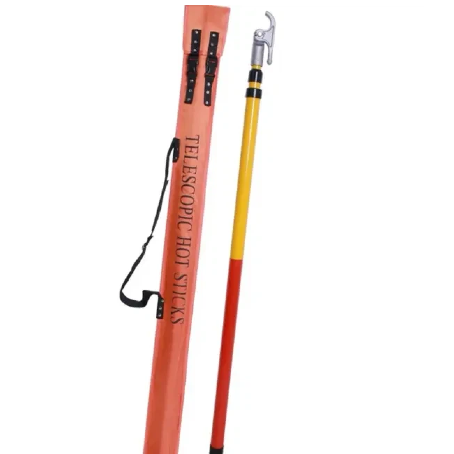
A switch must be opened on an energized feeder. A fuse cutout needs to be replaced before the next load peak. The line is treated as live, and the crew cannot afford a direct approach. In moments like this, the question becomes practical and urgent: how can a technician operate high-voltage equipment without becoming part of the electrical path? The answer lies in the design and correct use of a hot stick. Understanding how a hot stick works is not only about theory—it directly affects safety, compliance, and the selection of the right tool for each task.
This article explains, in plain language, how a hot stick functions as a live-line tool, what makes it safe, what can quietly reduce its safety margin, and how different structural designs influence performance in real operating environments.
The safety idea is distance first, insulation second
The most important principle behind a hot stick is not the material. It is distance. Electricity seeks the easiest path to ground. When a worker increases the physical distance between their body and energized equipment, the risk of accidental contact and arc exposure is significantly reduced.
A hot stick creates that controlled distance. It allows the operator to stand outside the minimum approach boundary while manipulating switches, disconnectors, or conductors. The insulating material is essential, but insulation alone is not the primary protective mechanism. The combination of safe working distance and high dielectric strength provides layered protection.
Keep-out zones and why a few extra feet matter
High-voltage systems do not only present contact hazards. They also present arc and flashover risks. Electrical arcs can bridge gaps when voltage levels are high enough, especially in humid or contaminated environments. Maintaining extra physical separation increases the safety margin.
Hot sticks are manufactured in various lengths to meet voltage class requirements. A longer tool increases approach distance. In transmission and substation work, this additional reach can mean the difference between compliant operation and unsafe proximity.
What a hot stick does not do
A hot stick is not a substitute for training, grounding procedures, lockout/tagout systems, or proper personal protective equipment. It does not eliminate electrical energy. It does not make energized parts harmless. Instead, it allows trained personnel to interact with energized components under controlled and regulated conditions.
Understanding this distinction is critical when evaluating whether a hot stick is appropriate for a task. The tool is part of a broader safety system.
What a hot stick is made of and why the surface matters
Most modern hot sticks are constructed from fiberglass-reinforced polymer. Fiberglass offers high dielectric strength, mechanical rigidity, and resistance to environmental stress when properly manufactured.
However, material selection alone does not determine safety performance. The surface condition plays a decisive role.
Fiberglass as a non-conductive structure
Fiberglass is widely used in live-line tools because it provides excellent insulation when dry and clean. Its internal structure resists mechanical bending and torsion, which is essential during switching operations or when applying force to hardware.
At ZHEJIANG JITAI ELETCIRC POWER EQUIPMENT CO.,LTD, hot sticks are produced using controlled curing processes and reinforced structures to ensure consistent dielectric performance and structural stability. This manufacturing discipline ensures that each pole maintains uniform insulation properties along its entire length.
Finish, contamination, and moisture films
The outer finish of a hot stick prevents moisture and contaminants from forming a conductive film. Dirt, salt deposits, industrial pollution, and even hand oils can reduce surface resistance. When moisture combines with contamination, the insulation performance can drop significantly.
A well-finished hot stick has a smooth, cleanable surface that resists tracking and surface discharge. Regular wiping and inspection are essential because even high-quality fiberglass can become unsafe if the surface is neglected.
This is why manufacturing quality and surface finishing standards matter. A durable coating simplifies cleaning and helps maintain dielectric reliability across varying environmental conditions.
How the work happens at the tip
A hot stick is not just an insulated pole. It becomes a working system through attachments. The tip converts reach and insulation into functional capability.
Universal heads and common attachments
Most professional hot sticks are equipped with a universal head fitting. This allows compatibility with C-hooks, disconnect hooks, fuse pullers, grounding attachments, voltage detectors, and other specialized tools.
Instead of carrying multiple insulated poles, crews can change attachments to match the task. For example:
Opening or closing a disconnect switch
Replacing a fuse cutout
Installing temporary grounding equipment
Performing voltage checks
This modular approach increases efficiency while maintaining safe working distance.
Why quick-change mechanisms matter
In live-line operations, minimizing handling time reduces exposure risk. Quick-release systems allow faster attachment changes without excessive manipulation. Telescopic disconnect tools designed with push-button locking systems enable one-handed operation and secure section engagement.
This design consideration is not cosmetic. It directly affects workflow speed, operator fatigue, and task precision.
Telescopic vs sectional designs
Different work environments demand different extension methods. Understanding how these systems operate helps users select the appropriate configuration.
Telescopic sections and locking systems
Telescopic hot sticks extend by sliding nested sections outward. Each section locks into place using mechanical locking buttons or twist-lock systems. When properly engaged, the structure maintains rigidity and prevents unintended collapse.
The advantage of telescopic design lies in transport convenience and adjustable reach. A compact collapsed length expands to several meters when needed. This makes it ideal for distribution line maintenance and substation switching.
High-quality telescopic designs maintain orientation during extension, preventing rotation that could misalign attachments. Stable locking mechanisms ensure safe force transmission during switching operations.
Sectional rods for modular reach
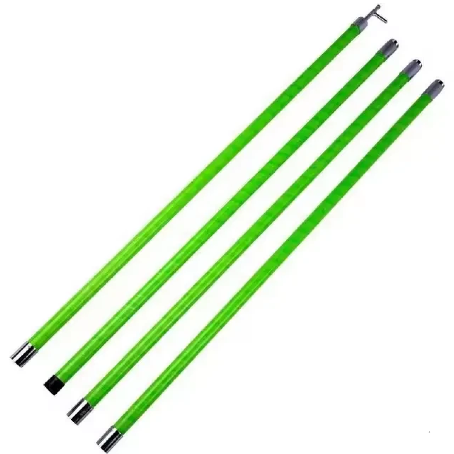
Sectional hot sticks consist of individual segments assembled to achieve the required length. This modular design offers flexibility for specialized tasks and easier replacement of individual sections if damaged.
Sectional rods are often preferred when crews require very long reach or need transport adaptability for confined access locations. The assembly method allows customization of working height while maintaining insulation integrity.
Both telescopic and sectional systems are available within the Telescopic Disconnect Tools range from ZHEJIANG JITAI ELETCIRC POWER EQUIPMENT CO.,LTD, giving operators flexibility across multiple applications.
Where hot sticks are used most
To understand how hot sticks work, it is helpful to see where they are commonly applied.
Distribution and substation operations
Hot sticks are widely used for:
Operating load break switches
Opening and closing disconnects
Switching capacitor banks
Replacing fuse cutouts
Installing grounding clamps
Performing voltage testing
These tasks require controlled mechanical force at a safe distance. The insulated pole transmits that force while maintaining separation from energized components.
Emergency restoration vs planned maintenance
In emergency restoration, speed and adaptability are critical. Telescopic hot sticks with quick-release attachments support rapid task changes.
In planned maintenance, modular sectional rods may be selected for customized reach and controlled workflow. The design choice depends on frequency of use, environmental exposure, and specific operational requirements.
By offering telescopic, triangular heavy-duty, and sectional operating rods, ZHEJIANG JITAI ELETCIRC POWER EQUIPMENT CO.,LTD supports diverse scenarios across transmission, distribution, and industrial facilities.
Table — Hot stick parts and what each part protects you from
Component | What it does | What to check |
Fiberglass pole body | Provides insulation and reach | Cuts, cracks, dull finish, tracking marks |
Surface coating | Prevents moisture and contamination film | Clean condition, no sticky residue |
Telescopic locking mechanism | Holds extended length securely | Firm lock, no wobble |
Universal head fitting | Secures attachments | Tight fit, no corrosion or looseness |
Grip section | Ensures stable handling | No slippage, no material damage |
This breakdown highlights that every element contributes to safety performance. A hot stick works effectively only when each component is intact and properly maintained.
Why manufacturing quality directly affects performance
Consistency in fiberglass layering, curing temperature control, surface finishing, and locking mechanism design determines whether a hot stick maintains dielectric strength over time.
ZHEJIANG JITAI ELETCIRC POWER EQUIPMENT CO.,LTD operates advanced inspection equipment and quality management systems to ensure each hot stick meets structural and electrical performance standards. Products undergo inspection before shipment, supporting compliance and safety documentation requirements for international markets.
Because hot sticks operate in critical safety conditions, reliability is not optional. It is engineered.
Conclusion
Hot sticks work because they allow trained personnel to operate energized equipment from a controlled distance using an insulated and well-maintained surface. The principle is simple, but the execution requires precision manufacturing, correct configuration, and disciplined inspection. When selecting a live-line tool, consider reach requirements, attachment compatibility, environmental conditions, and structural stability. Explore the Telescopic Disconnect Tools range from ZHEJIANG JITAI ELETCIRC POWER EQUIPMENT CO.,LTD to find a configuration that matches your operational needs. For specifications, technical consultation, or bulk inquiries, contact us today.
FAQ
1. What voltage levels can a hot stick be used for?
Hot sticks are manufactured in various lengths and ratings to match medium and high-voltage systems. The required length depends on minimum approach distance and system voltage.
2. Can a hot stick be used in wet weather?
Fiberglass offers moisture resistance, but surface contamination combined with water can reduce insulation performance. Always follow operational safety procedures and inspect the surface before use.
3. Why does surface cleaning matter for a hot stick?
Contaminants can create a conductive path along the surface. Regular cleaning maintains dielectric strength and prevents tracking.
4. What is the difference between telescopic and sectional hot sticks?
Telescopic hot sticks extend through sliding sections for adjustable reach, while sectional rods assemble in segments for customized length and modular flexibility.


